Posts

Showing posts with the label Projects & ideas

Space servers

Image
  One of the benefits of Elon Musks' Starlink space internet is that it provides a lower-latency connection between points on earth. It does this because the speed of light in a vacuum is faster than the speed of light in fibre and so even though the beams have to travel slightly further* they travel that distance faster. Although this is great for long-distance zoom chats the real financial benefit of this is to high-frequency traders who make a living from the small arbitrage opportunities that exist between geographically separate exchanges. To that end, I conjecture that not long after the public release of Starlink and its proven utility to high-frequency traders, those trading firms will start to deploy their algorithms to servers in orbit. Why? To lower the latency. If the algorithm doesn’t need to send the signal to space before it executes then it can receive the signals from both exchanges in L/2 and after deciding to trade send the trading request at L/2 leading to a bli...

The equation for a sunset

Image
 I’ve always been a big fan of sunsets. I get some really nice ones most evenings in the summer from my current flat but with winter approaching I wanted to try and make something virtual and consistent. One of my goals was that after I got my quest 2 to try and sit coding with a sunset in the background. There are a number of issues on the road to realising that dream in its entirety however I got a long way with watching the sunset over the ocean. Bellow, I present a shader (Code dedicated to programing the shader section of the graphics card pipeline) for a sunset over ocean waves. Ocean waves in deep water are much easier to generate than shallow-water waves as you can get away modelling them as not interacting with anything. That permits an ontogenetic style where you can skip to the future without calculating the intermediate steps. The surface is based on the sums of sin waves which is not true to how water actually moves as it moves in  Gerstner waves . So I based the ...

Cost a sustainable development of timber

Image
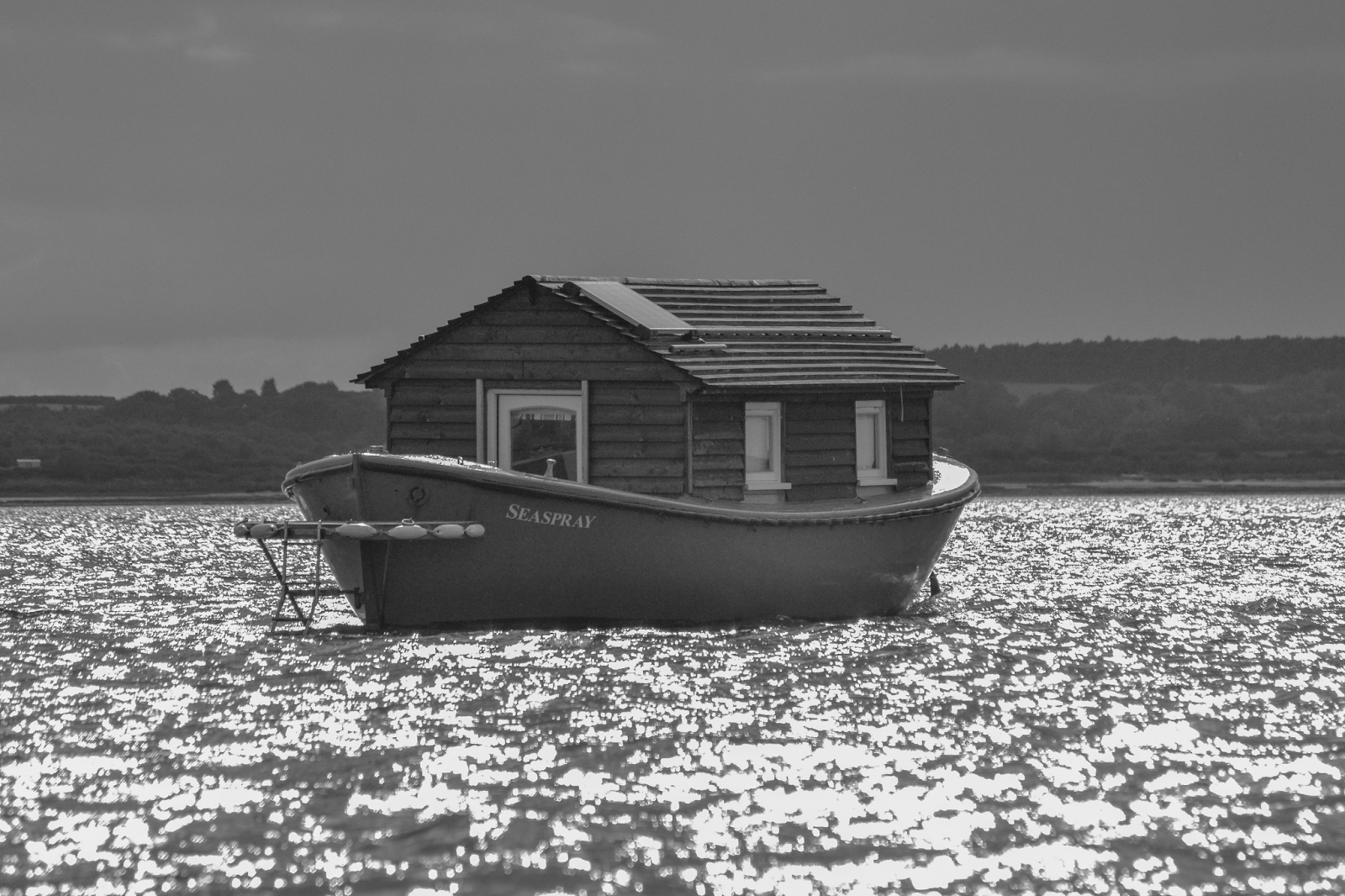
Wood is a great material (You might say I’m biased, son of a timber merchant and all that) but it can be both cheap and expensive. The oxymoronic nature of that comes from the fact that compared to plastics wood is expensive and compared to metals it is cheap. One of the things I’d like to explore in this post is an idea that came to me when exploring what could be done with regards to expanding land into the sea . On land, you are, in the modern-day limited not by the cost of the development you wish to create but by the ability to get permission from the powers that be to construct that development. The cost of raw land in the UK has not increased much faster than inflation over the years while the cost of housing has far outstripped the rate of inflation. The discrepancy is in large part to the limitation on the ability to develop the raw land into a property. Clearly, this is a desirable state of affairs in that we don’t want to cover the British isles with concrete blocks but equa...

Custom work from home desk

Image
As you may have noticed from the other posts on this blog I enjoy making things. I try as much as possible to make useful things, despite what my girlfriend says about the paper mache tower . In May this year, I was starting a new job and with it coming up to a year in the flat my girlfriend and I were considering if we needed more room. One of the issues was that we didn’t have a sofa and with both of us working from home, we didn’t really have anywhere to put a sofa. I was considering starting to go back into the office again, at least part-time and so looked into the idea of a desk that would fold out over a sofa for when I needed it, but that would fold away when I didn’t. It was quite hard to find something to meet this specification. Most of the fold-away desks just don’t work over a sofa and those that do are too small to work off. I thought that given the simple nature of a desk as a piece of furniture I would have a go at conceiving of something that would be perfect for my si...

A failed attempt to prove Mark Twain wrong

Image
  Mark Twain is famous for his quote "Buy land they aren't making any more of it". This is an under-edited post exploring the costs of making more floating land out of fibreglass boxes that you can then have sitting in the ocean. Living in Britain the cost of land is very high, at least compared to any kind of global average. I've been wondering if a super low-cost construction on the water could ever be cheaper. Starting with some reference numbers: https://www.travisperkins.co.uk/mdf-hardboard-and-pinboard/standard-hardboard-panel-2440mm-x-1220mm-x-3mm/p/500013 8.36/sheet https://www.mbfg.co.uk/225gm_csm.html 2080 for 16*120m rolls 0.95m width 225gsm 1.14 GBP/ m^2 https://www.cfsnet.co.uk/acatalog/Web_FibreglassGuide.pdf Google claims this source says 2 layers for 300gsm https://www.travisperkins.co.uk/planed-softwood-timber/redwood-planed-square-edge-5th-25-x-50mm-finished-size-20-5-x-44mm/p/180032 Beams at 2GBP/meter 8 sheets 4 beams 2440 4 screws per panel Cost o...

Londoncentric world map

Image
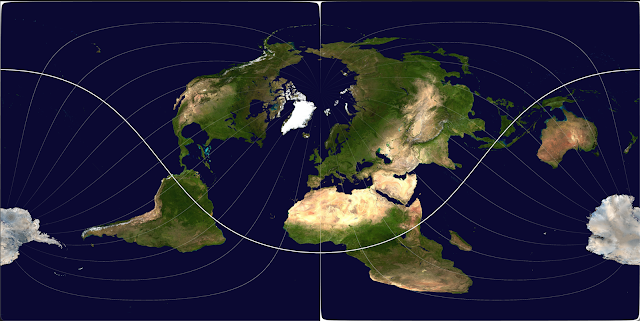
  Some people think that the world map centred on Greenwich is an unnecessary layover from the times of empire. Of Course, many countries issue maps with themselves more central. Living in London, with the nassim I have for home I felt that the longitude being centred in Greenwich wasn’t enough. I thought that the latitude should also be centred in Greenwich. The majority of world maps use what is called the Mercator projection. This is a projection based on putting the sphere of the world inside a cylinder. The position of a location on the globe projected onto this cylinder is then where it occurs on the map. This has the nuance of distorting the polls and making areas closer to the poles much larger than they actually are. There have been many attempts to change the projection using other techniques that push the distortions to different places. There are maps that attempt to keep the relative surface area of countries accurate to life. The nature of creating a flat representati...

Heating with bitcoin: What? Why?

Image
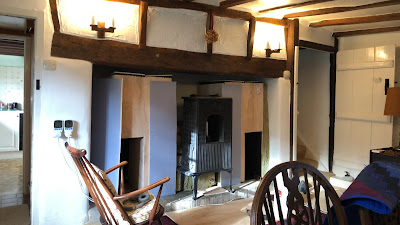
This is a post in part to help my Nana explain to people what the noisy thing in her dining room is and why anyone would want that. This is the first post in a series. What why? Will it be worth it How to silence the thing I have spent the weekend at my Nanas house after travelling to Newport last week (You could still buy petrol back then). Last week I went to pick up an Antminer s19 pro. It’s a very special computer. To the core of it, the following is what the system looked like when I left it last. This large boxed system behind the wood-burning stove is mostly hollow air chambers. The actual computer looks like this, the sound is the reason for the hollow air chambers. The heating system in this chocolate box cottage is direct electric. That means that the electricity is passed through a wire, the resistance of that wire causes heat, that heat is used to warm the house. The reason this is such an expensive way to heat a house is mainly because it is compared to a regular gas boile...

The phoneme thing about speech recognition

I have many google homes in my flat. I use them to turn on the lights, set timers, do unit conversions and play ocean sounds. I wouldn’t consider their speech recognition to be good. My girlfriend with her feminine voice has an even harder time with them, often resorting to putting on a comedic deeper voice to get google to recognise her commands. I’ve looked into how speech recognition is done and when building my computer back in January one of the goals I had for it was to train my own language model. I’ve written about ideas I have for getting the computer to recognise language before. My understanding of the most up-to-date techniques for language recognition is to use a CTC network to train between the audio and words. The training data that is used is labelled speech. That would consist of a mp3 file of someone saying a sentence and then a text file or record of that sentence. The audio file will then be decomposed into a frequency analysis creating an image like the following w...

Staring into the [render] distance

 I've had my oculus quest for some months now and I've been thinking about how I can make the best sunset experience possible. One of the ideas that I was exploring was that of prerendering. Since in a sunset experience, I don't expect the user to be able to move much out of their drawn area, there is going to be a maximum distance for which they can discern parallax. Using the area I can draw out, a 2m x 2m square, we can calculate how far away in virtual space an object needs to be before its motion from parallax would be sub-pixel. A      B  |\     |  | \    |  |  \   |  |   \  |  |    \ |  |     \|  C      D Using the above diagram, we need to calculate at what distance The oculus quest has a pixel density of 20 pixels per degree. That means that each pixel is 0.05 degrees in the field of view. From that we need to calculate at what distance away from the...

Simple repetition; yesterday's news

Image
Over the last year in lockdown, I’ve tried out a lot of little experiments, in an attempt at following my sister's mantra of a parcel a day keeps covid at bay we ended up with a lot of cardboard in the house. After my previous post, wondering about the strength of layers of cardboard I decided to try and make a rock formation that would act as a vertical planter. Starting with the cardboard I built out a ridiculous structure folding the strips of cardboard into triangular based prisms with the intent that this would allow for the most strength. Then after buying 5 litres of PVA glue off amazon and collecting as many evening standards as I could I covered the structure slowly in paper-mache. I spent far too many hours going over and over the structure in layer upon layer of paper-mache. I barely made a dent in my supply of newspaper which for all intents and purposes was an unlimited supply, nor did I make a dent in the 5 litres of glue. The structure took to a shape, not really ver...

An idea for a cheaper robotic arm.

Image
Robotic arms are expensive! Even if you build your own and don’t include your own labour in the cost they can still be prohibitively expensive. One of the major costs is the stepper motors which are used in almost all robotic arms. They are often used directly in place on the arm as well and that direct drive means that arms which can lift anything substantial, are expensive. The motors being on the joints of the arm add to the weight of the arm which may have a large effect on what the arm can lift. What isn’t expensive is the standard brushed motors used in cheap hovers, RC-cars and fans. Last year I was doing a lot of thinking about home automation, having got a new flat during the summer. I finally had a reason to get wifi lights and a few google homes to control them with. One thing that I noticed about home automation systems is that they are all focusing on automating things that were never really an issue in the first place. Turning on lights ...

Popular posts from this blog

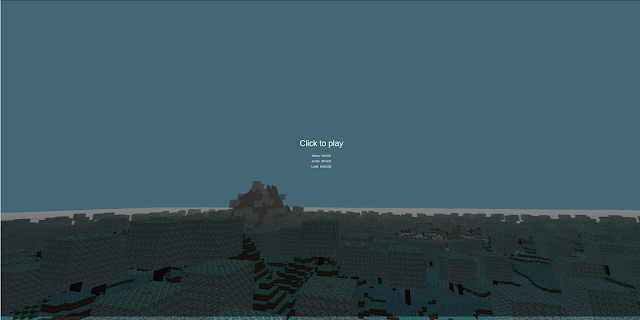
THREE.js: minecraft in a weekend

Greedy meshing in javascript

Custom work from home desk